
10 July 2026
How to Sharpen a Knife: Step-by-Step Guide
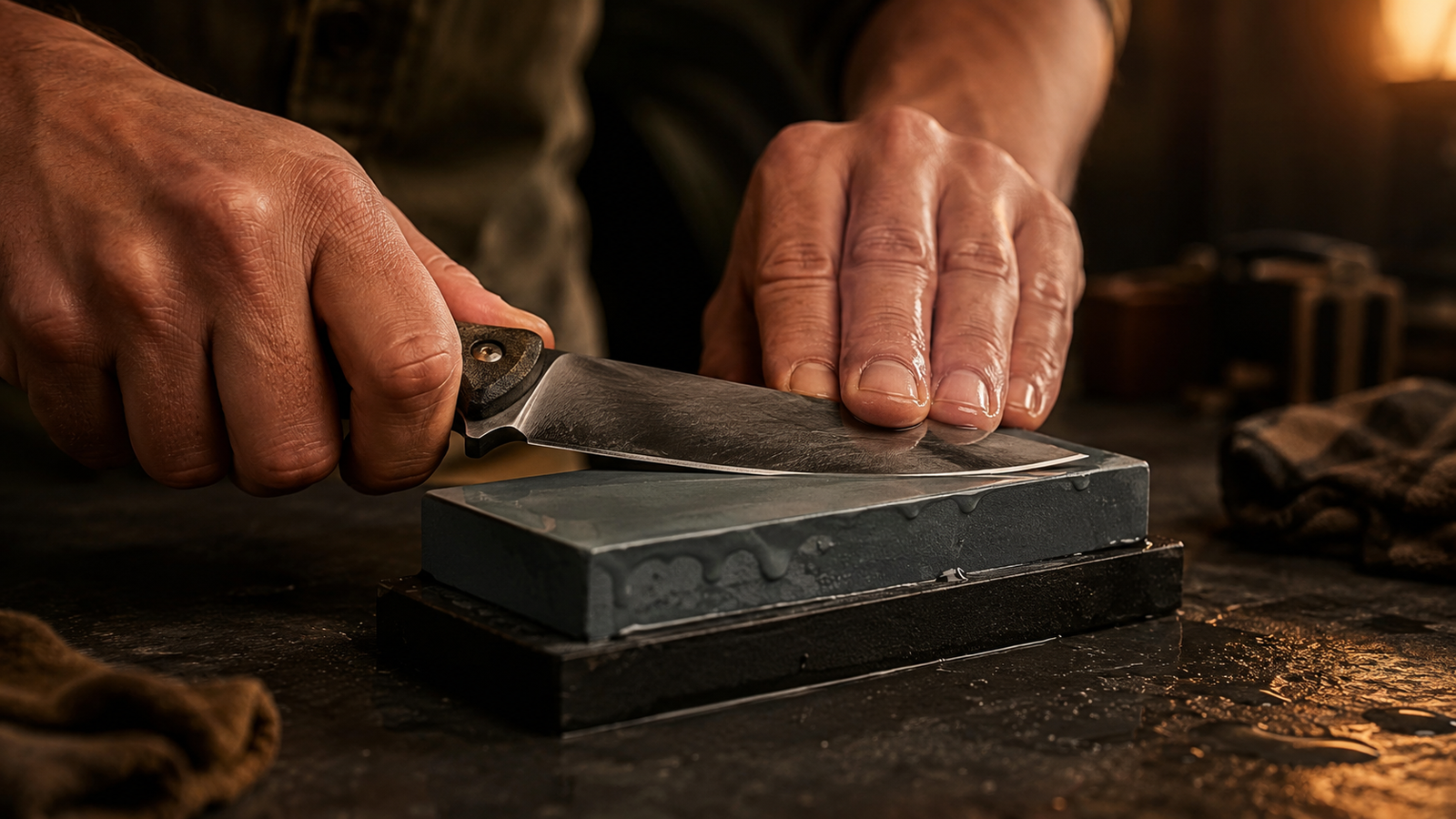
To sharpen a knife, hold the blade against a sharpening stone at a consistent 15–20° angle, then draw it edge-first across the stone, alternating sides and working from a coarse grit up to a fine grit until a small burr forms and the edge bites cleanly into paper. That is the whole skill in a sentence — everything below shows you how to do it properly, whether you are using a whetstone, a guided system, a honing rod or a pull-through sharpener.
A sharp knife is a safe knife. A dull edge slips, forces you to push harder and does more damage when it slides off the cut — so learning to put a proper edge back on a blade is the single most useful skill any knife owner can have. The good news: almost any knife, from a budget folder to a premium fixed blade, can be brought back to shaving-sharp with a little patience and the right technique.
What you'll need
You do not need a workshop full of gear. To sharpen a knife well you need one of the following, plus a few minutes:
- A sharpening stone (whetstone) — the classic, most versatile option, usually a combination of a coarse and a fine side.
- A guided or pull-through sharpener — the easiest route if you want a repeatable angle without practice.
- A honing rod for quick edge maintenance between sharpenings.
- Optionally, a leather strop to polish the edge to a razor finish at the end.
A cloth, a little water or honing oil for your stone, and a stable surface complete the kit.
What angle should you sharpen a knife at?

Angle is the part most people get wrong. As a rule of thumb, sharpen most knives at 15–20° per side:
- 15–17° — kitchen and Japanese knives, where a keen slicing edge matters more than toughness.
- 18–20° — everyday carry, outdoor and hunting knives; the best all-round balance of sharpness and durability.
- 22–25° — hard-use, chopping and survival blades that need a tougher, more impact-resistant edge.
The exact number matters less than consistency. Holding the same angle for every stroke is what creates a clean, even edge — which is exactly why guided systems exist. If you are unsure what your blade can take, our knife steel guide explains how different steels hold an edge.
How to sharpen a knife with a whetstone (step by step)

The whetstone is the most versatile way to sharpen a knife and the method worth learning first. Here is the process:
- Prepare the stone. Soak a water stone for 5–10 minutes until the bubbles stop, or add a few drops of oil to an oil stone. Place it on a non-slip surface with the coarse side up.
- Set your angle. Lay the blade flat on the stone, then lift the spine until the edge sits at roughly 15–20°. A useful trick: two stacked coins under the spine of a normal-sized blade is close to 15°.
- Sharpen the first side. Keeping that angle, push the edge across the stone as if you were trying to shave a thin layer off it, from heel to tip. Use light, even pressure and repeat 8–10 strokes.
- Feel for the burr. Carefully run a fingertip away from the edge on the opposite side. A tiny rough lip — the burr — means you have sharpened all the way to the edge.
- Sharpen the second side. Flip the knife and repeat until you raise a burr on the other side. Match the number of strokes to keep the edge centred.
- Move to the fine grit. Turn the stone over (or move to a higher-grit stone) and repeat with lighter strokes. This refines the edge and removes the burr.
- Strop to finish. A few passes on a leather strop, spine-first, polishes the edge to a clean, hair-shaving finish.
How to use a honing rod
A honing rod (sometimes called a sharpening steel) does not actually remove much metal — it realigns an edge that has rolled over with use. Hold the rod vertically, tip on a cloth, and draw the blade down and across it at your sharpening angle, alternating sides for 5–6 light strokes each. Do this often and your knife stays keen far longer between full sharpenings. Browse honing rods and steels here.
Guided and pull-through sharpeners: the easy route

If holding a freehand angle sounds fiddly, a guided system does it for you. Clamp-style sharpeners hold the blade while a rod tracks a fixed, repeatable angle — giving near-professional results with almost no practice. Pull-through sharpeners are even simpler: draw the blade through pre-set carbide and ceramic slots for a fast, functional edge, ideal for kitchen knives and quick touch-ups. For hands-off convenience, electric sharpeners handle the whole job in seconds.
Not sure which style suits you? Our guide to the different types of knife sharpeners breaks down the pros and cons, or shop complete sharpening sets that include everything you need.
How to tell when your knife is sharp

Three quick tests tell you when to stop:
- The paper test. Hold a sheet of paper and slice down through it. A sharp knife glides through cleanly; a dull one snags and tears.
- The light test. Look straight down at the edge under a light. A sharp edge is invisible; any dull spots catch the light and glint back at you.
- The thumbnail test. Gently rest the edge on a thumbnail at a shallow angle — a sharp edge bites and holds, a dull one slides.
Grit progression: which grit for what
Sharpening stones are graded by grit, from coarse to fine. Knowing which to use saves time:
- 120–400 grit — repairing chips and re-profiling a very dull or damaged edge.
- 600–1000 grit — general sharpening; this is where most edges are actually set.
- 2000–6000 grit — refining and polishing a working edge to keen sharpness.
- 8000 grit and up (and stropping) — mirror-polishing for a razor finish.
Most people only ever need a combination 1000/6000 whetstone — coarse enough to sharpen, fine enough to finish.
Common knife-sharpening mistakes
- Changing the angle mid-stroke — the number one cause of a dull result. Lock your wrist.
- Using too much pressure — let the abrasive do the work; heavy pressure rounds the edge.
- Skipping the burr check — if you have not raised a burr, you have not reached the edge.
- Stopping too coarse — always finish on a finer grit or a strop for a lasting edge.
- Sharpening a dry water stone — keep it wet so the slurry can cut.
How often should you sharpen a knife?
Hone little and often, sharpen only when needed. A quick pass on a honing rod every few uses keeps an edge aligned for weeks. A full sharpening on a stone is only needed when honing no longer restores the bite — for most everyday users that is every few months, and more often for a hard-working kitchen or outdoor knife.
Frequently asked questions
Can you sharpen a knife without a stone?
Yes. Pull-through and electric sharpeners, honing rods, and guided systems all sharpen without a traditional whetstone. In a pinch, the unglazed base ring of a ceramic mug can put a temporary edge on a blade.
What is the best angle to sharpen a knife?
15–20° per side suits most knives. Use 15–17° for kitchen and slicing knives, 18–20° for everyday and outdoor knives, and 22–25° for tough, hard-use blades.
Does sharpening damage a knife?
No — correct sharpening removes only a tiny amount of steel to restore the edge. Over-aggressive grinding or a wrong angle is what wears a blade down prematurely, which is why consistency matters.
What is the difference between honing and sharpening?
Honing realigns an edge that has rolled over and removes almost no metal; sharpening grinds a new, keen edge. You hone often and sharpen occasionally.
Every sharpener we sell is genuine, brand-new, authorized-dealer stock. Explore the full range of knife sharpeners, whetstones and strops at Black Country Outdoor.